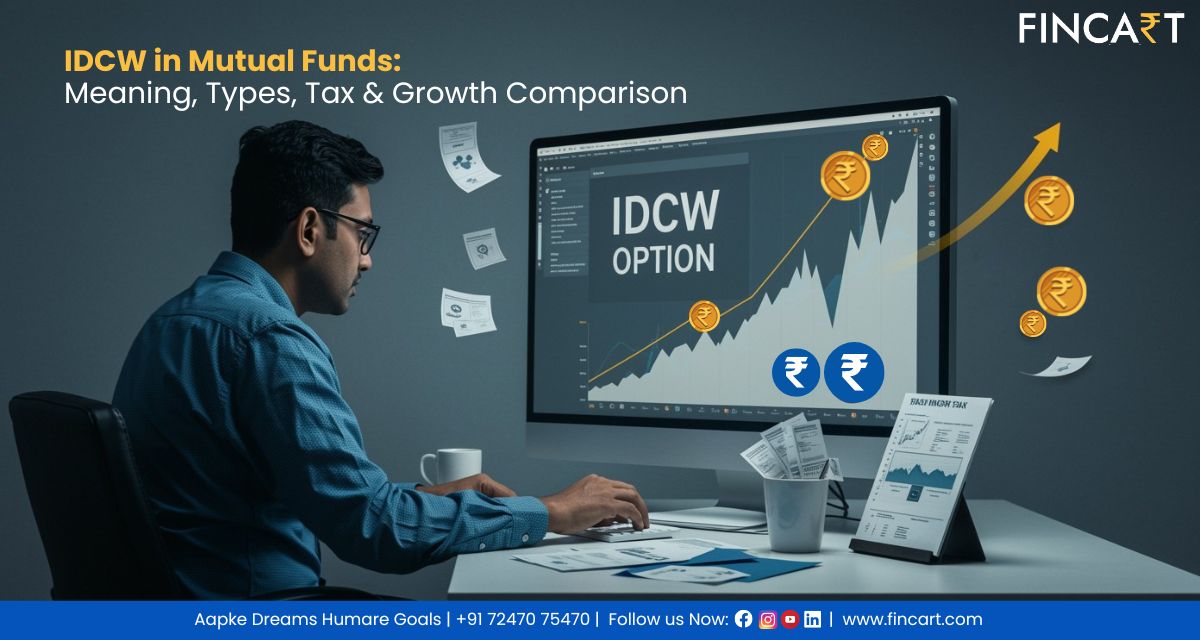
IDCW (Income Distribution cum Capital Withdrawal) is a common feature in mutual funds, yet it remains poorly understood. Many investors view it as a source of regular income, while others treat it as an additional return. In reality, it is neither of these things in isolation, and these assumptions can lead to sub-optimal investment decisions. IDCW in mutual fund options primarily offer one thing: periodic cash flow from an existing investment. For investors who value liquidity or interim income, this can be useful. It allows money to move from the fund to the investor without redeeming units manually. But this convenience comes with its own trade-offs. IDCW affects the scheme’s NAV, interrupts compounding, and creates immediate tax liabilities. These aspects are often noticed only after the payouts are received.
Understanding how IDCW works therefore requires looking at both sides together – what it offers and what it costs cannot be separated. This article explains how IDCW works, its types, taxation, and a numerical comparison with the Growth option.
What Is IDCW in Mutual Fund?
IDCW stands for Income Distribution cum Capital Withdrawal. It was earlier known as the dividend option in mutual funds. From April 2021, SEBI (Securities and Exchange Board of India), required all fund houses to adopt the IDCW label instead. The intent was to remove the impression that these payouts resemble company dividends or represent incremental profits for investors. This revision in terminology makes the structure clearer. IDCW in mutual fund schemes reflects a distribution from the fund’s own value, not an independent income stream. The payout changes how returns are delivered, not how much the investment earns.
When IDCW is paid, money moves from the scheme to the investor. At the same time, the scheme’s Net Asset Value reduces by the payout amount. The investor receives cash, but the overall investment value remains broadly similar before tax. This distinction is important and often missed. IDCW does not create extra returns. It simply changes the form in which returns are received.
Types of IDCW in Mutual Fund
Mutual funds offer two IDCW variants. The difference lies in how the distributed amount is handled.
IDCW Payout Option
Under the payout option, the IDCW amount is credited directly to the investor’s bank account. The number of units remains unchanged, but the scheme’s NAV reduces after the payout. This option provides cash flow, but the amount and timing are unpredictable. IDCW payouts can be skipped or reduced at any time. Tax is applicable on every payout received.
IDCW Reinvestment Option
Under the reinvestment option, the IDCW amount is not paid in cash. It is reinvested into the same scheme at the post-IDCW NAV and additional units are allotted to the investor. The NAV still falls on IDCW declaration. Tax still applies, even though no cash is received. Many investors mistakenly assume reinvestment avoids taxation, which is incorrect.
How does IDCW Reinvestment Differ From Growth Option?
Although IDCW reinvestment appears similar to Growth, their underlying mechanics are very different:
- In IDCW reinvestment, the scheme first declares IDCW, reduces the NAV, and then reinvests the distributed amount. This triggers immediate taxation, even though the investor does not receive any cash.
- In contrast, the Growth option allows returns to remain invested without interruption. There is no distribution, no NAV cut, and no interim tax liability. Tax is payable only at redemption, which preserves compounding and improves post-tax outcomes.
The distinction is not driven by reinvestment mechanics, but by tax timing and compounding efficiency. Under the IDCW reinvestment option, tax becomes payable each time a distribution is declared, which creates incremental tax leakage over time. The Growth option, by contrast, allows returns to remain invested and defers taxation until redemption. Because of this structural difference, investors with a long-term investment horizon may find the Growth option more efficient. IDCW reinvestment does not typically offer an advantage in such cases and can result in lower post-tax outcomes over time. Discussing the choice with a mutual fund advisor can help align the option selected with time horizon, tax profile, and cash flow needs.
How IDCW Option Works: Declaration, Payment, and Taxation
How IDCW Is Declared and Paid
IDCW declaration depends entirely on the AMC. It considers available surplus, liquidity, and prevailing market conditions. There is no linkage to a fixed schedule. The process typically follows these steps:
- The AMC announces IDCW and the record date
- Investors holding units on the record date become eligible
- NAV adjusts downward after the record date
- Payout or reinvestment is processed
Monthly or quarterly labels are indicative, not contractual. IDCW should not be treated as a predictable income stream.
Taxation of IDCW in Mutual Funds
Taxation is the most important factor when evaluating IDCW. IDCW from equity mutual funds is taxed at the investor’s applicable slab rate. It is added to total income and taxed accordingly. TDS may apply if payouts exceed specified thresholds. For investors in higher tax brackets, this significantly reduces post-tax returns. Frequent IDCW payouts also create repeated tax events.
IDCW from debt mutual funds is also taxed at slab rates. There is no indexation benefit. The tax impact is often higher compared to capital gains taxation under the Growth option. For investors in the 30 percent slab, IDCW from debt funds can be particularly inefficient.
Comparison with Growth Option Taxation
In the Growth option, no payouts are made during the holding period. The NAV compounds over time. Tax is payable only at the time of redemption. This allows investors to:
- Defer tax liability
- Benefit from compounding on the full amount
- Potentially pay lower effective tax
IDCW in mutual fund options create ongoing tax leakage. Growth options delay taxation and improve efficiency.
IDCW Payout Option vs Growth Option
A numerical illustration helps clarify the long-term impact of IDCW versus Growth.
Assume an investor puts ₹10,00,000 into the same equity mutual fund. The fund delivers a gross annual return of 12% over a 10-year period. The only difference is the chosen option.
Scenario 1: IDCW Option
Assume the fund distributes 6% annually as IDCW. The remaining return stays invested.
- Annual IDCW declared: ₹60,000
- Investor tax slab: 30%
- Tax paid on IDCW each year: ₹18,000
- Net IDCW received annually: ₹42,000
Over 10 years:
- Total IDCW declared: ₹6,00,000
- Total tax paid on IDCW: ₹1,80,000
- Net cash received: ₹4,20,000
Since the distributed portion no longer compounds, only the retained return continues to grow. In effect, the invested corpus compounds at roughly 6% annually.
- Approximate portfolio value after 10 years:
₹10,00,000 × (1.06)¹⁰ ≈ ₹17,90,000
Total post-tax value under IDCW option:
- Final portfolio value: ₹17,90,000
- Net IDCW received: ₹4,20,000
- Total: ₹22,10,000
Scenario 2: Growth Option
Under the Growth option, no payouts are made. The entire investment compounds at 12% annually.
After 10 years:
- Final value: ₹10,00,000 × (1.12)¹⁰ ≈ ₹31,05,000
- Total gains: ₹21,05,000
- LTCG tax at 12.5%: ₹2,63,125
Post-tax value under Growth option:
- ₹28,41,875
The difference is substantial. But it does not arise because IDCW delivers lower returns before tax. It arises because:
- A portion of returns stops compounding every year
- Taxes are paid repeatedly instead of being deferred
- Growth allows compounding on the full amount
IDCW in mutual fund options convert part of long-term returns into current cash flows. Growth option converts time into capital appreciation. The choice is therefore not about performance. It is about cash flow versus compounding efficiency. While IDCW in mutual funds prioritizes cash flow, Growth option prioritizes wealth creation.
Who Should Consider IDCW Option?
IDCW can be suitable in limited situations. It is not inherently bad, but it is often misused.
IDCW may suit:
- Retirees with low taxable income
- Investors needing periodic cash flow
- Short-term income requirements
IDCW may not suit:
- Long-term wealth builders
- Investors in higher tax brackets
- Goal-based investors
For investors with overlapping income needs and tax considerations, a discussion with a mutual fund advisor can help determine whether IDCW fits within their broader portfolio strategy.
Switching Between IDCW and Growth Options
Investors are not locked into their initial choice. Mutual fund schemes allow switching between IDCW and Growth options at any time. Investors can do so by submitting a switch request either through their mutual fund consultant or directly via the fund’s online platform.
However, switching between IDCW and Growth options is not a simple internal adjustment. From a tax and cost perspective, it is treated as a redemption from the existing option followed by a fresh investment into the new one. As a result:
- Exit load may apply, if the switch occurs within the specified period
- Capital gains tax becomes payable, based on the holding period and asset class
Because of these implications, switching decisions should be made with care. Frequent or reactive switches can lead to avoidable tax outflows and disrupt long-term investment planning. In many cases, discussing the implications with a mutual fund consultant can help align the decision with tax considerations and long-term goals.
Common Myths About IDCW in Mutual Funds
Many misconceptions continue to influence decisions.
- IDCW is not extra income. It is a distribution of existing value.
- IDCW does not improve returns. It often reduces post-tax outcomes.
- IDCW is not guaranteed or fixed.
- IDCW does not reduce market risk.
Understanding these realities prevents disappointment later.
FAQs on IDCW in Mutual Funds
Q: Is IDCW similar to interest income?
A: No. IDCW is not interest income. Interest is paid on a fixed principal at a predetermined rate. IDCW, by contrast, is a discretionary distribution from a mutual fund’s own value and depends on surplus availability and market conditions.
Q: Is IDCW payout guaranteed? What frequency can investors expect? A: IDCW payouts are not guaranteed. While some schemes indicate monthly or quarterly IDCW options, the actual declaration depends entirely on the fund house. There is no obligation to maintain any frequency, and payouts can be skipped without notice.
Q: Is the IDCW payout amount or percentage constant?
A: No. The payout amount or percentage is not fixed. It can vary across periods based on market performance, surplus levels, and the AMC’s decision at the time of declaration.
Q: Is IDCW suitable for retirees?
A: IDCW can be suitable for retirees who require periodic cash flows and fall in lower tax brackets. It may not be efficient for retirees with other income sources or higher tax exposure.
Disclaimer: This article is intended solely for informational and educational purposes. It does not constitute investment advice, tax advice, or a recommendation to buy, sell, or hold any mutual fund scheme or option. Mutual fund investments are subject to market risks.ly for informational and educational purposes. It does not constitute investment advice, tax advice, or a recommendation to buy, sell, or hold any mutual fund scheme or option. Mutual fund investments are subject to market risks.