ESG Investing – Meaning, Example, Metrics and How It Works

ESG investing has emerged as one of the most significant shifts in global financial markets. It represents an approach where investment decisions consider not only financial performance but also a company’s impact on the environment, its treatment of people, and the strength of its governance practices. This shift reflects a growing belief that long-term value is closely linked to responsible behaviour, sustainable resource use, and ethical management.
This unique investment approach has recently gained considerable attention because businesses today operate in an environment heavily impacted by climate risks, regulatory pressures, social expectations, and the need for transparency. ESG investing provides a structured way to evaluate how companies respond to these forces.
What is ESG Investing?
ESG investing refers to an approach where investment decisions consider a company’s environmental, social, and governance practices along with its financial performance. It is commonly understood as a ‘sustainable’ approach to investing. It emphasises long-term resilience by examining how businesses manage their impact on the world around them while pursuing growth.
The three pillars of ESG each address distinct aspects of corporate responsibility:
Environmental factors examine how a company uses resources and manages issues such as carbon emissions, pollution, waste, water usage, and energy efficiency.
Social factors assess how the company treats employees, maintains workplace safety, supports diversity, engages with communities, and manages relationships with customers and suppliers.
Governance factors focus on leadership quality, board independence, ethical conduct, compliance, transparency, and the strength of internal controls.
At its core, ESG investing implicitly evaluates how an organisation behaves, how it manages risks, and how it prepares for future challenges. These assessments offer insights that traditional financial metrics may not capture.
Many investors integrate ESG factors into their regular analysis to build more resilient portfolios. This approach is also supported by investment consultant teams and investment advisory services, which increasingly include ESG frameworks when evaluating potential opportunities.
What Do The ESG Investing Metrics Measure?
ESG metrics provide a structured way to evaluate how responsibly and effectively a company operates. They convert broad ideas (such as environmental responsibility or ethical leadership) into measurable indicators that allow comparisons across businesses and industries. These metrics help assess long-term risk, operational quality, and overall sustainability.
Environmental Metrics
Environmental metrics reflect how a company manages its impact on natural resources and the climate. Common measures include:
Carbon emissions across direct and indirect activities
Total energy consumption and the share sourced from renewable energy
Water usage, recycling efforts, and waste-management practices
Climate-related policies, targets, and progress toward reducing environmental risks
These indicators reveal how prepared a company is for a world facing rising climate pressures and regulatory changes.
Social Metrics
Social metrics examine how a company interacts with employees, customers, and the wider community. They often include:
Workplace safety performance and incident rates
Diversity, equity, and inclusion indicators such as gender representation
Employee turnover, training programmes, and overall workforce wellbeing
Policies related to customer protection, data privacy, and community engagement
These measures help highlight the strength of a company’s internal culture and its relationships with stakeholders.
Governance Metrics
Governance metrics assess the quality of leadership, decision-making, and oversight within an organisation. Key measures include:
Board independence, diversity, and relevant expertise
Strength of audit practices and internal financial controls
Alignment between executive compensation and long-term performance
Transparency in disclosures and the handling of related-party transactions
Strong governance practices often indicate responsible management and reduced operational risk.
Why ESG Investing Matters Today
ESG investing has gained importance as global markets face greater environmental pressures, rising social expectations, and increased scrutiny of corporate behaviour. Companies are now evaluated not just on financial results, but also on how responsibly they manage resources and relationships.
Several factors explain why ESG investing matters today:
It helps reduce legal and reputational risk as regulations grow stricter.
It highlights long-term costs linked to environmental damage and social issues.
It reflects a company’s readiness for future policy and compliance requirements.
It supports decision-making that aligns financial objectives with responsible practices.
It offers a more complete view of long-term performance and business resilience.
Many investors use ESG filters with the support of an investment consultant or through investment advisory services to understand how these factors influence potential outcomes.
How ESG Investing Developed Worldwide
ESG investing has developed steadily over the past few decades. It began with early ethical investing, which avoided companies involved in harmful industries such as tobacco or weapons. Over time, sustainability and corporate responsibility gained recognition, especially after the 1990s with global initiatives like the Rio Earth Summit. The term ESG was popularised in the mid-2000s, alongside frameworks like the UN Principles for Responsible Investment, which encouraged integrating environmental, social, and governance factors into financial decisions.
In the last decade, ESG investing has become mainstream, with large asset managers and institutions incorporating ESG into portfolio strategies. Regulatory support, improved reporting standards, and growing awareness of long-term risks have strengthened its adoption. Today, ESG investing is data-driven, performance-focused, and widely regarded as a tool for assessing both ethical responsibility and financial resilience.
Growth and Progress of ESG Investing in India
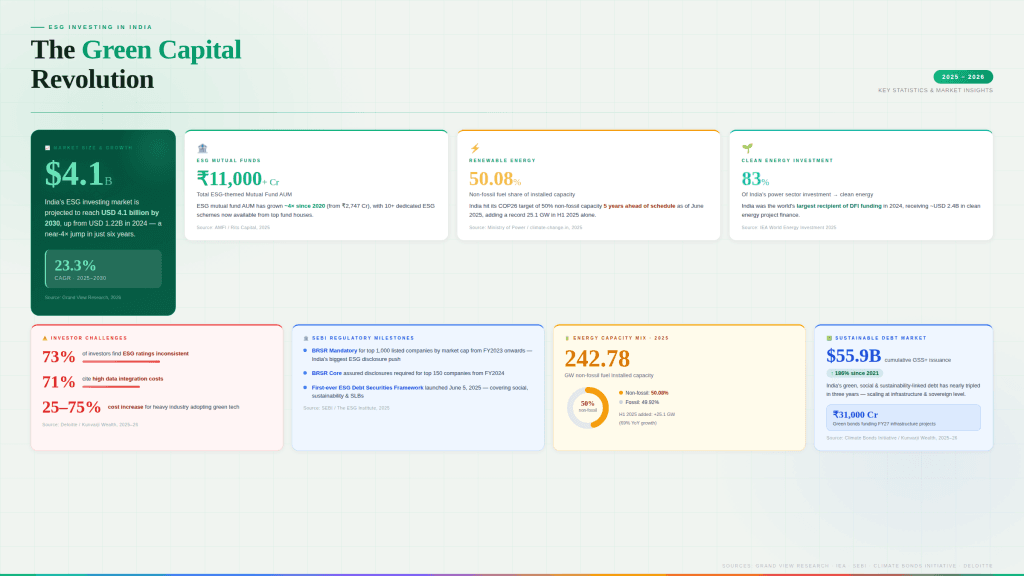
ESG investing in India has grown rapidly in the past decade. Early efforts began with voluntary corporate responsibility disclosures and sustainability initiatives. In 2012, SEBI introduced the Business Responsibility Report (BRR) for the largest listed companies, making basic ESG reporting mandatory. This framework was strengthened in 2021 with the Business Responsibility and Sustainability Report (BRSR), providing more detailed disclosure standards.
Since then, ESG-focused mutual funds and portfolio strategies have come up steadily. The broader investment ecosystem is gradually integrating ESG considerations into analysis, signalling continued expansion and deeper adoption in the years ahead.
How to Invest Using ESG Principles
ESG investing offers multiple strategies and investment vehicles that allow investors to align their portfolios with sustainability goals. Understanding these approaches helps clarify how ESG principles translate into practical investment decisions.
Common ESG Investment Strategies
Investors can choose from several established strategies when incorporating ESG factors into their portfolios:
Negative screening involves excluding industries or companies that conflict with ESG principles, such as tobacco, gambling, weapons manufacturing, or those with records of environmental violations or human rights concerns. This approach allows investors to avoid sectors that do not align with their values.
Positive screening focuses on actively selecting companies that demonstrate strong ESG performance across environmental, social, or governance dimensions. Rather than simply avoiding poor performers, this strategy seeks out leaders in sustainability and responsible business practices.
Best-in-class selection identifies the top ESG performers within each sector or industry. This approach recognises that every sector has companies making greater efforts toward sustainability, allowing investors to maintain diversified portfolios while still prioritising ESG excellence.
Thematic investing concentrates on specific ESG themes such as renewable energy, clean technology, water conservation, or affordable healthcare. These focused strategies target companies directly contributing to particular environmental or social solutions.
Impact investing goes beyond selecting responsible companies by targeting investments that generate measurable social or environmental benefits alongside financial returns. This might include microfinance institutions supporting rural entrepreneurs, renewable energy projects in underserved communities, or affordable housing developments.
These strategies can be combined or applied gradually depending on the investor’s objectives, risk tolerance, and values. Many investors use multiple approaches simultaneously to create portfolios that reflect their specific priorities.
ESG Investment Vehicles
ESG-Focused Mutual Funds and ETFs
One of the most accessible ways for Indian investors to implement ESG strategies is through mutual funds and exchange-traded funds that follow ESG criteria. These funds screen companies based on environmental, social, and governance performance before including them in their portfolios.
Several Indian asset management companies now offer ESG-themed funds that invest in companies meeting specific sustainability benchmarks. These funds typically exclude businesses involved in controversial activities while favouring companies with strong climate policies, diverse leadership, and transparent governance structures.
Individual Stock Selection
Investors can also build ESG portfolios by selecting individual companies demonstrating strong sustainability practices, like:
A technology company that powers its operations with renewable energy, maintains transparent data privacy policies, and ensures fair labour practices across its supply chain represents strong ESG alignment.
Financial institutions that incorporate climate risk into lending decisions, promote financial inclusion, and maintain independent board oversight exemplify governance-focused practices.
Manufacturing companies that reduce resource consumption, invest in employee safety, and publish detailed sustainability reports demonstrate comprehensive ESG commitment.
Green Bonds and Sustainable Debt
Indian investors can participate in ESG investing through green bonds, which are debt instruments specifically issued to fund environmentally beneficial projects. These might include renewable energy installations, clean transportation infrastructure, or energy-efficient building projects. The funds raised are earmarked exclusively for projects with measurable environmental benefits, providing investors with fixed-income opportunities aligned with sustainability goals.
Combining Approaches for Customised Portfolios
Many sophisticated investors combine exclusionary and inclusionary methods to create tailored portfolios. For example, an investor might exclude certain sectors entirely while actively seeking ESG leaders within acceptable industries. Others might dedicate a portion of their portfolio to thematic investments in renewable energy while maintaining broader ESG-screened holdings elsewhere.
This flexibility allows ESG investing to accommodate different investment horizons, risk appetites, and personal values while maintaining focus on long-term sustainability and responsible corporate behaviour. The approach selected often depends on whether the investor prioritises avoiding harm, actively supporting positive change, or achieving specific impact outcomes alongside financial objectives.
Is ESG Investing Suitable for You?
ESG investing tends to suit investors who prioritise long-term stability and want portfolios that account for both financial and non-financial risks. It aligns well with those who prefer companies demonstrating responsible conduct, strong governance, and sustainable growth practices.
It may not be ideal for investors who prefer high-risk investments, short-term strategies, or for those who do not wish to review additional ESG-related information. In such cases, professionally managed ESG funds can offer a simpler route. Investment consultant teams and investment advisory services often help assess suitability and identify appropriate options.
Advantages and Challenges of ESG Investing
Like any investment approach, ESG investing comes with distinct benefits and limitations. Understanding both sides helps investors make informed decisions aligned with their financial goals and personal values.
Advantages
Long-term risk management: ESG analysis identifies potential risks such as regulatory changes, environmental disruptions, or governance failures before they impact financial performance.
Values alignment: Investors can support companies that reflect their principles while pursuing financial returns.
Growing institutional momentum: Increasing adoption by major investors and regulatory bodies may enhance long-term value for ESG-focused companies.
Enhanced transparency: ESG frameworks encourage better disclosure of company operations, risks, and impact.
Competitive returns: Research suggests ESG investments can deliver performance comparable to or better than conventional approaches over the long term.
Challenges
Lack of standardization: ESG ratings vary significantly across providers, making consistent company comparisons difficult.
Data quality concerns: Incomplete or unverified disclosures, particularly from smaller companies, complicate accurate assessment.
Diversification constraints: Strict ESG criteria may limit investment options and concentrate risk in specific sectors.
Potentially higher costs: ESG-focused funds may carry higher expense ratios due to additional research and screening requirements.
Subjectivity: Definitions of “responsible” investing vary among individuals, making ESG a somewhat subjective framework.
These trade-offs are not absolute, and their relevance depends on individual circumstances, investment horizons, and priorities.
Popular ESG Mutual Funds in India
As of December 2025, here’s how leading ESG funds have performed:
Funds | 3 Yr Ret (%) | 5 Yr Ret (%) |
ICICI Prudential ESG Exclusionary Strategy Fund | 18.20 | 15.73 |
SBI ESG Exclusionary Strategy Fund | 13.21 | 14.77 |
Quant ESG Integration Strategy Fund | 12.79 | 24.27 |
Aditya Birla Sun Life ESG Integration Strategy Fund | 14.17 | – |
BSE 100 TRI | 14.07 | 16.41 |
Thematic: ESG category average | 13.31 | 15.23 |
Fund policies differ, so reviewing the latest factsheets and disclosures is essential before investing.
Conclusion
ESG investing represents a structured approach to incorporating environmental, social, and governance considerations into investment decisions. As this framework continues to evolve in India and globally, investors have access to expanding strategies and investment vehicles that can be tailored to individual goals.
For investors exploring ESG options, working with an investment consultant or investment advisory service can provide valuable guidance in navigating ESG ratings, fund selection, and portfolio construction. As the ESG landscape develops, staying informed about regulatory changes and market trends remains important for incorporating sustainability considerations into investment decisions.
Tags: ESG Investing
Read Important Disclosures