

Financial planning is the process of setting goals, budgeting, saving, and investing to achieve life objectives. For Indian millennials (born ~1981–1996, now mostly aged 25–44), planning is crucial because they face high inflation, rising living costs, and long-term goals like buying homes or funding children’s education. A 2024 survey found 85% of young Indians cite high living expenses (food, rent, utilities) as their biggest savings challenge. Effective planning helps millennials build discipline: for example, 93% of young Indians report saving regularly, often setting aside 20–30% of income each month. Yet many still feel unprepared: a Bajaj Allianz study showed 73% of millennials feel they have not done enough retirement planning. This gap highlights the need to start early and plan intelligently. By understanding budgeting, debt, investment, and protection, Financial planning for millennials can secure their financial future despite economic uncertainties.
Savings & Investing Trends Among Young Indians
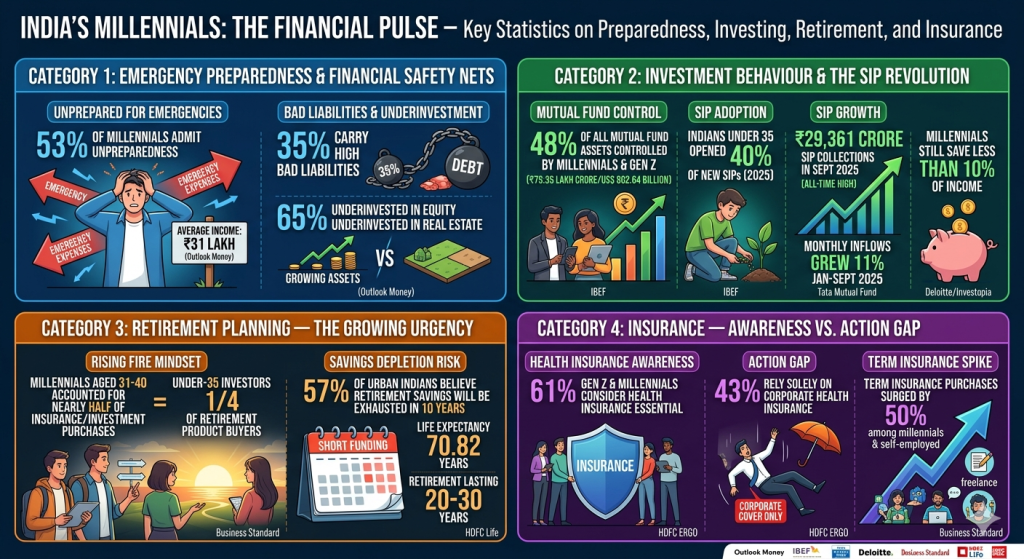
Millennials in India are adopting new saving and investment habits. Data shows an encouraging trend: the majority of young adults are saving consistently. In fact, 93% of Indians aged 18–35 identify as regular savers. Of those, most save about 20–30% of their monthly income. Many use digital tools to automate this: about 68% of young savers utilize automated apps or bank features to set aside funds regularly.
Tech and Saving: Millennials increasingly rely on fintech apps for saving and investing. According to a 2024 report, 62% of them use YouTube to learn financial tips, and 68% use automated savings tools. Automated investment platforms like SIPs (Systematic Investment Plans) are especially popular among the youth, making it easy to invest small amounts consistently.
On the investment side, millennials are leading a shift toward market-linked assets. A 2024 Nielsen/Fin One survey found 58% of young Indians invest in stocks, while 39% invest in mutual funds. In contrast, only 22% still rely on traditional fixed deposits and 26% on recurring deposits. Notably, in the 18–21 age group, nearly 72% favor stocks[7]. An official industry report confirms this strong bias: between FY2019 and FY2023, new mutual fund investors were 54% millennials, and their share of new investors peaked at 57% in FY2020. In FY2022 alone, over 2.5 million millennials made their first mutual fund investments. This data shows millennials are embracing equities and funds as key growth tools.
However, millennials also face risks. Easy credit and high expenses pose pitfalls. Many young Indians rely on credit cards and loans for purchases: one survey reports 72% of millennials have borrowed money for non-essential spending, which can hinder their ability to save or invest. Credit card debt has surged in India; by mid-2024, outstanding card debt hit ₹2.7 lakh crore, and defaults rose to ~1.8%. In other words, 58% of millennials admit to overspending via credit cards, often at the expense of building an emergency fund. These trends underscore why disciplined planning is needed: without a clear plan, high-interest debt and impulsive spending can derail financial goals.
Managing Debt & Expenses
Young Indians must be cautious with debt. Beyond education loans (which average over ₹7 lakh per student), common debts include home loans, personal loans, and credit cards. To stay on track:
- Build an emergency fund. Aim to save 3–6 months of living expenses in liquid accounts like savings account or short-term funds. This buffer prevents high-cost borrowing when unexpected costs arise.
- Avoid unnecessary loans. Take loans only for high-return investments (like education or home). A survey found 72% of millennials borrowed for non-essentials – try to break that habit. Use strategies like paying more than the minimum on loans, and refinance if better rates are available.
- Control spending. Track expenses with a simple app or spreadsheet. Prioritize needs over wants. Millennials can leverage payment technologies (UPI, mobile wallets) to stick to budgets.
By curbing avoidable debt and building savings, millennials free up more money for investing and growth.
Essential Steps of Financial Planning for Millennials
Building a solid financial plan involves clear, actionable steps. Below are six key steps tailored for young Indians. Following these in order can create a strong foundation for long-term wealth.
Step 1: Set Clear Financial Goals
What do you want to achieve? First, identify short-term (1–3 years), medium-term (3–7 years), and long-term goals. Examples include an emergency fund (short-term), a down payment on a home (medium), and retirement corpus or children’s college (long-term). Assign timelines and estimated costs to each goal. For instance, if you aim to buy a car in 2 years, determine how much to save monthly. According to surveys, millennials are motivated by goals like family security and travel. Write down goals like “save ₹5 lakh for house by 2030” or “retire with ₹50 lakh corpus.” Clear goals help prioritize saving and guide investment choices.
Step 2: Create a Budget & Emergency Fund
Once goals are set, create a realistic budget. Track your income and expenses: list fixed costs (rent, utilities, EMIs) and variable costs (food, entertainment). Aim to follow the 50-30-20 rule as a guideline: 50% needs, 30% wants, 20% savings/investment. Use budgeting apps (like Money View or Monefy) to automate tracking and receive alerts when spending exceeds limits.
Alongside budgeting, build an emergency fund. This fund (3–6 months of expenses) acts as a safety net against job loss or emergencies. Keep it in a liquid account (like a high-yield savings account or short-term debt fund). The ETBFSI report emphasizes that overspending is a top pitfall: 58% of millennials fall into a “credit pit,” neglecting emergency savings. By saving first in an emergency fund, you’ll handle shocks without resorting to high-interest loans.
If you have any existing debt (education loan, credit card dues, personal loan), include debt repayment in your budget. Prioritize high-interest debt first (like credit cards). Try to pay more than the minimum due; for example, paying an extra ₹1,000 toward a credit card balance or loan principal can significantly reduce interest costs over time. Consider these tactics:
- Avalanche method: Pay off the debt with the highest interest rate first.
- Snowball method: Pay off the smallest balance first for quick wins.
- Refinance: Check if you can shift high-interest loans to lower rates (e.g., a balance transfer credit card or bank loan).
Avoid new unnecessary debt by using cash or debit for discretionary purchases. Remember: according to a fintech blog, 72% of millennials regret borrowing for non-essentials, as it hurts future investment plans. Keep credit card balances low (ideally below 30% of the limit). Use credit cards smartly: pay off the bill each month to avoid interest, and treat them as budgeting tools to earn rewards.
Step 4: Invest Wisely (Stocks, Mutual Funds, etc.)
With a solid budget and some initial savings, focus on investing. Millennials have a long investment horizon, which allows for risk-taking and compounding growth. Key options include:
- Systematic Investment Plans (SIPs) in Mutual Funds: This is the most popular route. SIPs let you invest a fixed sum monthly into equity or hybrid funds. They are tax-efficient and suitable for disciplined investing. Over FY2019–23, millennials formed 54% of new mutual fund investors, showing strong preference for this medium. Equity mutual funds historically give ~8–12% annual returns over long terms, higher than fixed deposits (6–7%). You can start SIPs with as low as ₹500/month on platforms like Groww, Zerodha Coin, or ET Money. SIPs also automatically average out market volatility.
- Direct Stocks: For those interested in the stock market, retail trading platforms like Zerodha, Upstox, and ICICI Direct make investing in individual stocks accessible. Stocks carry higher risk but potentially higher returns (10–15%+). Limit direct stock investments to a portion of your portfolio (for example, 20–30%) unless you have strong knowledge. Use research tools (like Moneycontrol charts) and consider blue-chip or index stocks initially.
- Tax-Saving Investments (80C Options): To maximize tax efficiency, invest up to ₹1.5 lakh per year under Section 80C. Tax saving options under Old Tax Regime include Public Provident Fund (PPF), Employee Provident Fund (EPF, which you contribute to if salaried), and Equity Linked Savings Schemes (ELSS) – a type of mutual fund. ELSS funds have a 3-year lock-in, but they grow with equity market and enjoy equity tax rates. NPS (National Pension System) also offers additional deductions (₹50,000 under Section 80CCD). These instruments both save tax and build savings.
- Fixed Income and Alternatives: Keep some allocation to low-risk assets. PPF and EPF (government schemes) offer ~7–8% returns tax-free, though they lock up funds. Fixed deposits or recurring deposits in banks/PSUs can park short-term savings (use 1-2 year FD rates around 6–7%). Gold is a traditional hedge; consider Sovereign Gold Bonds or digital gold for convenience. If interested, small exposure to real estate or gold can diversify your portfolio.
- Investment diversification: A balanced plan mixes assets. For example, one might split investments into equity (60%), debt (20%), and gold/real estate (20%). Consider age-based allocation (e.g., older millennials may shift more to safer assets). The key is consistent investing. Even small monthly SIPs compound dramatically over decades. As one expert notes, the power of compounding means even small savings grow significantly with time.
Step 5: Plan for Retirement (NPS, PPF, EPF)
Retirement may seem far off, but early planning is critical. Government and employer programs can help:
- Employee Provident Fund (EPF): If you’re salaried, a portion of your salary (along with employer’s contribution) goes into EPF at ~8-8.5% interest (8.25% for the financial year 2025-26). This grows tax-free until retirement (age 60). Continue this as the core of retirement corpus.
- Public Provident Fund (PPF): A government scheme with 15-year lock-in; current rate ~7-8%. You can deposit up to ₹1.5 lakh/year, gaining tax-free returns. It’s very safe, making it ideal for medium- to long-term security.
- National Pension System (NPS): This government-backed pension scheme lets you save in equity, corporate bonds, and government securities. It has a low entry barrier and offers additional tax benefits. Many financial experts highlight NPS as attractive: it provides a mix of market exposure and guaranteed annuity at retirement. You can open an NPS account via banks or online eNPS portal.
Even as you invest in markets, make retirement planning active: consider your target corpus and use retirement calculators. If possible, increase retirement contributions with each salary hike. The Bajaj survey shows 73% of millennials feel they lack sufficient retirement planning, so prioritizing even small deposits early can make a big difference. Aim to take advantage of employer contributions and tax savings to build a secure retirement fund over time.
Step 6: Insurance & Protection for Risk Management
A key but often overlooked part of planning is protection. Insurance safeguards your financial goals against unforeseen events:
- Health Insurance: Medical costs in India can be high. Even young adults should have a health plan. Millennials are aware of this – about 63% have already considered or purchased health insurance. Seek a family floater plan to cover self and dependents. Compare plans on features (cashless network, coverage, premiums) via portals like PolicyBazaar or directly with insurers (ICICI Lombard, Star Health, etc.). Ideally, aim for coverage at least 10–15 times your annual income.
- Life Insurance (Term Insurance): If you have a family or debts, term life insurance is essential. A term plan gives a large payout to your nominees if you pass away, securing their needs. Millennials seem to understand this: 35% plan to buy term cover (vs only 19% of Gen Z). Experts recommend coverage of 10–20 times your annual salary. Term plans from HDFC Life, SBI Life, or Axis Max Life can cost as low as a few thousand rupees per year for young non-smokers. Buying early locks in low premiums.
- Other Protections: Consider income protection (critical illness riders or disability cover) if you have high-risk factors, and appropriate motor or home insurance. These are usually secondary but important. Overall, insurance should be viewed as a foundational layer of any plan. Just as you invest for goals, ensure you protect against the worst-case scenario. As one survey noted, millennials are more inclined than Gen Z to prioritize insurance for life stability. Use online comparison tools and buy direct from insurers to avoid unnecessary middlemen fees.
Leveraging Advisors & Digital Tools
Financial planning can be complex. Financial planning for Millennials have two main pathways: DIY planning or seeking professional help. Each has pros and cons:
- Self-Directed (DIY): Using online calculators, blogs, and apps, you can plan on your own. This is cost-effective and gives full control. Many millennials are doing this: apps like Groww, Zerodha, ET Money, and Moneycontrol empower users to research and invest directly. Robo-advisors (e.g. Scripbox, smallcase, Clearfunds) offer algorithmic investment portfolios based on your risk profile. DIY is best if you’re comfortable learning on your own. Pros: Low fees, educational, flexible. Cons: Risk of mistakes due to lack of experience, time-consuming.
- Professional Advisors: Certified financial planners or investment advisors (RIA) can design a comprehensive plan. They may charge a fee (or earn commission from products). A Bajaj Allianz survey found over 50% of millennials want expert guidance to achieve life goals, and nearly half cite lack of planning support as a barrier. A good advisor (e.g. CFP-certified) can personalize asset allocation, suggest optimal tax-saving instruments, and help adjust your plan as life changes. They also keep you disciplined. Pros: Expertise, personalized strategy, saves time. Cons: Fees/commissions.
- Hybrid Approach: Use digital tools for day-to-day investing, but consult an advisor for big decisions or yearly reviews. For example, many rely on YouTube and blogs for general tips (62% millennials do so). But when tackling complex issues like retirement planning or taxes, an expert can add value.
In terms of tools, here are a few popular ones among Indian millennials:
- Budgeting Apps: Monefy, MoneyView, or Walnut to track expenses and budget.
- Investment Platforms: Groww, Zerodha Coin, ET Money, Paytm Money – all allow mobile investing in stocks and mutual funds.
- NPS & Government Portals: The NPS eNPS portal (by NSDL) and the annual EPFO passbook app keep track of pensions.
- Info Resources: RBI’s “Bank Sakhi”, SEBI’s investor education site, and websites like Investopedia and blogs by EMI calculators.
By combining DIY resources with occasional expert advice, millennials can build a robust plan that leverages technology while avoiding common pitfalls.
Summary
Start Early & Save Consistently: Young Indians are already savers (93% save regularly). Aim to save at least 20–30% of income monthly for future goals and emergencies.
Set Goals & Budget: Clearly define goals (short vs. long term) and create a realistic budget. Build an emergency fund of 3–6 months’ expenses to handle life’s surprises.
Control Debt: Avoid high-interest loans and credit card overspending. Pay off debt aggressively (72% of millennials regret borrowing for non-essentials). Keep credit utilization low (ideally under 30%).
Invest for Growth: Use SIPs in equity mutual funds and stocks for long-term goals (millennials dominate new MF investments). Balance this with safe instruments (PPF/EPF for tax breaks). Diversify across assets (equity, debt, gold).
Plan for Retirement: Don’t postpone retirement savings. Contribute to EPF, PPF, and NPS now to leverage compounding. Even small monthly investments accumulate significantly over decades.
Get Insured: Protect yourself with health and life insurance. 35% of millennials plan to buy term life cover, and over 60% consider health insurance. This protection underpins your entire financial plan.
Seek Help When Needed: Use financial apps and robo-advisors to manage day-to-day investing, but don’t hesitate to consult a certified planner for major decisions. Over 50% of millennials say they need expert advice for life goals.
By following these steps—goal setting, budgeting, debt management, investing smartly, and protecting against risks—millennials can build wealth and confidence. Remember to periodically review your plan (at least annually) and adjust as your life circumstances change (new job, marriage, home, etc.). A structured approach makes financial freedom achievable even in a challenging economy.
FAQ
1. What is financial planning for millennials?
Financial planning for millennials involves setting short- and long-term financial goals and creating a roadmap to achieve them. It includes budgeting, saving regularly, investing in suitable instruments (like stocks and mutual funds), managing debt, and securing insurance. The aim is to build wealth for milestones such as buying a home, funding education, and retiring, while handling uncertainties. In short, it’s about planning money today to meet tomorrow’s needs.
2. How much should a millennial save or invest each month?
A common guideline is to save or invest about 20–30% of one’s income each month. Many young Indians follow this: around 93% of them save at least 20–30% of their earnings. The exact amount depends on your expenses and goals. First, ensure you cover necessities and build an emergency fund; then, direct a fixed portion of leftover income into investments or savings. Even starting with a small SIP of ₹500–1,000 per month can grow substantially due to compounding.
3. What are good investment options for young Indians?
Millennials have a long horizon, so they can benefit from growth-oriented investments. Popular options include:
- Equity Mutual Funds (through SIPs): Diversified and easy to manage, equity mutual funds give 8–12% returns historically over long terms.
- Stocks: Direct stocks can yield higher returns (10–15%+), but carry more risk. Beginners can buy shares of large and small companies via apps like Zerodha or Upstox.
- Tax-saving instruments: ELSS mutual funds (lock-in 3 years), PPF, and NPS offer tax deductions under Section 80C, making them efficient choices.
- PF/PPF: Government-backed and safe, PPF and EPF give ~7-8% returns, good for fixed returns.
- Other: Gold (Sovereign Gold Bonds or digital gold) and real estate (if affordable) can diversify your portfolio.
The key is to spread money across assets – for example, a mix of equity (for growth), debt (for stability), and some gold – aligned with your risk tolerance and goals.
4. Why should millennials consider a financial advisor or planner?
Millennials often have multiple goals (home, family, retirement) and limited time to manage finances. A certified financial advisor can provide expertise and personalized plans. A Bajaj Allianz survey found over 50% of millennials seek expert advice for achieving life goals. An advisor can optimize investments, navigate tax-saving opportunities, and adjust plans as life changes. They help avoid common mistakes like under-insuring or not taking enough risk. Alternatively, robo-advisors (like Scripbox or 5paisa) offer automated advice at lower cost. The choice depends on how much guidance you need versus doing it yourself.
5. What retirement planning steps should millennials take now?
Retirement may be decades away, but starting early is powerful. Millennials should:
- Contribute to EPF: If salaried, ensure full EPF deductions are taken. This grows tax-free.
- Open a PPF account: Invest up to ₹1.5 lakh/year for tax-free growth.
- Join NPS: Even small monthly contributions to the National Pension System add up. NPS offers market returns plus a mandatory annuity at retirement.
- Continue stock/mutual investments: Retirement goals can be funded via long-term equity investments too.
- Make retirement planning automatic: treat it like an expense. For example, set up an NPS SIP for a fixed amount from each salary.
6. How do I choose between mutual funds, stocks, and other assets?
It depends on your risk appetite and goals. Generally, beginners benefit from mutual funds because they are professionally managed and diversified. Equity funds are suitable for long-term growth. Stocks can supplement if you research specific companies. For short-term goals or low risk, consider debt funds, fixed deposits, or PPF. Gold and real estate can hedge inflation but invest only a small portion initially. Always balance risk: a rule of thumb is to invest your age as a percentage in debt (e.g., 25-year-old = 25% debt, 75% equity). As you age, gradually shift to safer assets. Diversification (not putting all eggs in one basket) is the guiding principle.
7. What mistakes should young people avoid in financial planning?
Common pitfalls include:
- Ignoring budgeting: Overspending on non-essentials is a major issue. One report noted 58% of millennials admit to impulsive credit card spending. Track expenses and cut unnecessary ones.
- Not saving emergency funds: Without this, unexpected costs lead to expensive debt. Always build a 3–6 month cushion.
- Late investing: Delaying investing can cost years of compounding. Even small monthly investments add up over time.
- Under-insuring: Skipping health or life insurance to “save” money leaves you exposed. In a Protection-first approach, ensure essential covers before luxury spending.
- Tax planning neglect: Many don’t maximize tax-saving options (ELSS, PPF, NPS). Missing out on these means losing part of your income to taxes unnecessarily.
Avoid these by sticking to your plan, automating savings/investments, and reviewing progress annually.
8. How do I find a good financial advisor in India?
Look for a SEBI-registered Investment Advisor (RIA) or a Certified Financial Planner (CFP). Check credentials (SEBI RIA registration is mandatory for advisors). Seek referrals from friends or check reviews of firms like Scripbox, Bajaj Allianz Wealth, or independent planners. Many advisors offer a first consultation free. Ensure they are fee-only (transparent) and not pushing specific products for commission. You can also use associations like FPSB India to find CFP professionals. Always verify experience (preferably someone who understands the challenges millennials face) and ask for a sample financial plan.