Tactical vs Strategic Asset Allocation: Which Approach Fits Your Investment Journey?
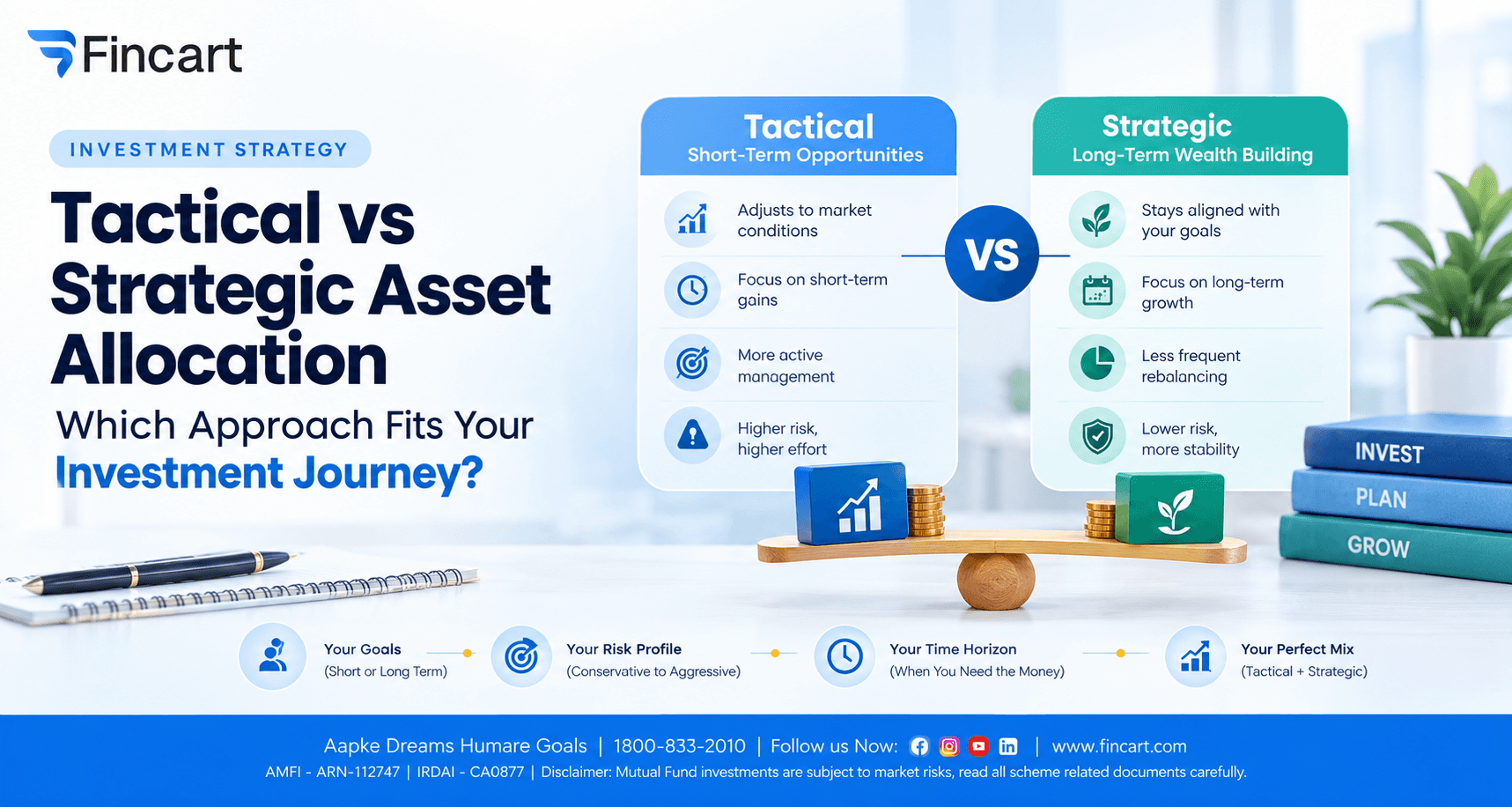
Every investor eventually asks some version of the same question: should I set my portfolio and leave it alone, or should I adjust it as markets move? That question of how actively you manage your asset mix is really what separates two fundamentally different approaches to investing.
Most financial advice stops at diversify: spread your money across asset classes, sit back, done. But diversification only answers what you own. It doesn't answer the harder question of how actively should you manage that mix once markets actually start moving?
That single question splits the investing world into two camps: strategic asset allocation and tactical asset allocation. Understanding Tactical vs Strategic Asset Allocation isn't just a theoretical concept; it's the decision that determines whether you stay steady during a market crash or end up making costly, emotion-driven moves at the worst possible time.
What is Strategic Asset Allocation?
Strategic asset allocation (SAA) is the practice of setting a long-term target mix across asset classes: say, 60% equity, 30% debt, 10% gold, based on your goals, risk tolerance, and time horizon. SEBI's investor education guidance similarly emphasises factors such as financial goals, risk tolerance and time horizon when making investment decisions.
Think of it as autopilot for your portfolio. Once the flight path is set, the plane doesn't jerk left every time it hits turbulence; it corrects gently and stays the course. In practice, this correction in turn is called rebalancing: if your equity allocation drifts from 60% to 68% after a rally, you trim the excess and route it back into debt or gold to restore your original targets.
Most investment advisory services recommend rebalancing once or twice a year, or whenever an asset class drifts a set percentage away from its target, not based on headlines, but on a predetermined rule.
The appeal of SAA is discipline. It removes emotion from the equation. You're not trying to predict the next six months of interest rate moves; you're building a portfolio designed to survive decades of them.
The whole mindset for this approach boils down to one line: "I've already made my decision. I don't need to remake it every time the market has a bad week."
It sounds almost too simple to work, and yet this is exactly the discipline most investment advisory services spend their time reinforcing, because staying put is far harder than it sounds once real money and real headlines are involved.
What Is Tactical Asset Allocation?
Tactical asset allocation (TAA) involves temporarily shifting a portfolio's asset mix away from its long-term target to respond to changing market conditions, valuations, economic signals, or other predefined indicators. These shifts can last months or extend over a few years, depending on the strategy and the signals driving it.
Let’s work this through an example:
In theory, a successful tactical strategy could reduce equity exposure ahead of a downturn and increase it again ahead of a recovery.
Tactical calls can be made in two ways:
Discretionary, where a fund manager or investment planner uses judgment and market reading to time the shifts.
Algorithmic/quantitative, where a rules-based model (tracking valuations, momentum, or volatility signals) triggers the moves automatically.
Either way, the core idea of Tactical vs Strategic Asset Allocation comes down to this: SAA trusts the plan; TAA trusts the moment.
Tactical vs Strategic Asset Allocation: Key Differences at a Glance
Factor | Strategic Asset Allocation | Tactical Asset Allocation |
Primary horizon | Long-term | Shorter to medium-term |
Allocation | Long-term target mix | Temporarily deviates from target |
Decision frequency | Periodic rebalancing | More frequent monitoring/changes |
Objective | Maintain intended risk/return profile | Seek additional return or manage risk |
Costs/tax | Generally lower turnover | Potentially higher turnover |
This table is the fastest way to grasp Tactical vs Strategic Asset Allocation at a glance, but the real decision depends on which trade-offs you're comfortable living with, not which one looks better on paper.
Pros and Cons of Tactical vs Strategic Asset Allocation
Strategic Asset Allocation
Pros: Lower costs, tax efficiency, behavioural discipline, easier to stick with long-term.
Cons: Rigid, doesn't capture short-term opportunities, can feel slow during fast-moving markets
Tactical Asset Allocation
Pros: Flexibility to respond to opportunities, potential to reduce downside during predictable downturns.
Cons: Higher trading costs, higher short-term capital gains tax, and critically, it requires you to be right twice: once when you exit, and again when you re-enter.
The Behavioural Angle: Why Sticking to the Plan Is the Hardest Part
When it comes to Tactical vs Strategic Asset Allocation, the most important decision isn't really about which strategy is mathematically superior. It's about which one you can actually follow when markets turn ugly.
Tactical allocation feels comfortable during volatility because it gives you something to do.
Selling before a crash feels like control. But this is exactly where two behavioural biases take over: loss aversion (the pain of losing money feels roughly twice as strong as the pleasure of gaining it) and recency bias (assuming that whatever the market did last week will keep happening). Together, they push investors to sell low out of fear and buy high out of fear of missing out, the precise opposite of profitable investing.
Strategic asset allocation doesn't eliminate this temptation; it just gives you a rulebook to fall back on when emotion takes over. The hardest part of SAA was never designing the 60/30/10 mix; it's holding that mix on the day the market drops 10% in a week. This is exactly why most experienced investment advisory services spend as much time managing client behaviour as they do managing portfolios.
Who Should Use Which? Finding Your Fit
Investors | Recommended |
New or passive investors, and young investors with a long runway | Strategic asset allocation. You have time to recover from downturns, and the discipline compounds in your favor over decades. |
Experienced, hands-on investors with higher risk tolerance and genuine market expertise | A larger tactical tilt may suit you, provided you have the time and temperament to monitor and act. |
Investors nearing retirement or relying on their portfolio for income | Strategic asset allocation should form the base, with only limited, carefully considered tactical tilts. |
If you're unsure which camp you fall into, this is precisely the kind of decision a qualified investment planner is trained to help you make objectively, rather than based on how confident you feel on any given day.
The Middle Path
Here's the part most retail investors never hear: professional portfolios rarely pick one side of the Tactical vs Strategic Asset Allocation debate exclusively. Instead, they often blend both through a core-satellite structure.
Core-satellite structure:
One way investors combine the two approaches is through a core-satellite structure — a larger strategic core paired with a smaller tactical allocation. The exact split depends on the investor's goals, risk capacity, and the strategy being used; there's no single "correct" ratio. Some investors run this as a 90/10 split, others closer to 70/30, and some hold no tactical satellite at all; the structure is a framework, not a fixed formula.
This structure gives you a way to combine the discipline and cost-efficiency of a strategic base with a smaller, contained "sandbox" for tactical bets that, even if they go wrong, are less likely to derail your long-term goals, since they sit alongside a stable core rather than replacing it..
At Fincart, this philosophy shows up directly in how portfolios are constructed.
Fincart's strategic asset allocation framework is Black-Litterman-inspired, a model adapted to make it accessible for individual investors with an explicit mandate to plan around timelines, not market noise.
Rather than reacting to headlines, the core allocation is built around each client's actual life goals, with structured quarterly reviews and continuous monitoring layered on top. Tactical shifts, where used, sit as satellite positions around this strategic core, not as the primary driver of the portfolio.
Costs, Taxes, and Real-World Frictions
Every tactical shift you make triggers real costs that eat into returns:
Transaction costs: More frequent trading directly increases brokerage and impact costs.
Tax drag: Gains held for less than 12 months in equity mutual funds are taxed as short-term capital gains, versus the more favorable long-term capital gains treatment for holdings beyond a year. This means frequent tactical trading can meaningfully increase your tax bill.
Time cost: Tactical strategies demand ongoing research and monitoring, a real cost even if it's not a monetary one
By contrast, India's data shows just how powerful low-friction, strategic discipline has become at scale.
As of July 2026, systematic investment plan (SIP) assets in India stood at roughly ₹18.19 lakh crore, nearly 21% of the entire mutual fund industry's ₹85.76 lakh crore AUM, built almost entirely through the strategic habit of investing a fixed amount every month, regardless of market noise. That's not a coincidence; it's the compounding payoff of a strategic-first mindset.
Interestingly, India's tactical products tell a more nuanced story.
Balanced Advantage Funds (BAFs), India's closest retail proxy for tactical asset allocation, managed about ₹3.23 lakh crore in assets as of December 2025, and actually outperformed flexicap, midcap, and smallcap categories in that turbulent year, delivering a category average return of 5.2% against a −5.5% showing for smallcap funds. It's a useful reminder that tactical approaches can work, but the wide performance spread between individual BAFs (from roughly 2.6% to 8.7% one-year returns among top funds) also shows just how much execution and fund-manager skill matters when you go tactical.
Quick Self-Assessment: Which Approach Fits You?
There's no single "correct" score here; this is meant to help you see which philosophy your instincts and circumstances lean toward, not to replace a conversation with a qualified investment planner about your specific situation.
Ask yourself | If this sounds like you… | You may lean toward |
Do you have time to monitor your portfolio regularly? | I’d rather set my allocation and check in occasionally. | Strategic |
I can track markets regularly and act when needed | Tactical / Core-Satellite | |
How do you behave during market crashes? | I’ve panicked or sold during past downturns. | Strategic |
I’ve stayed calm or even invested more during downturns. | Tactical / Core-Satellite | |
When will you need the money? | My goal is more than 7 years away. | Strategic |
I may need the money sooner. | Strategic with a lower-risk allocation | |
How much uncertainty are you comfortable with? | I prefer a more predictable, disciplined approach. | Strategic |
I’m comfortable with wider swings for potential outperformance. | Tactical / Core-Satellite | |
Do you have reliable research or professional guidance? | No — I’d mostly be making tactical calls myself. | Strategic |
“Yes — I have access to research or an investment professional. | Tactical / Core-Satellite |
Conclusion
There's no universal winner in the Tactical vs Strategic Asset Allocation debate and anyone claiming otherwise is oversimplifying a deeply personal decision. Strategic asset allocation rewards patience and discipline; tactical asset allocation rewards skill, time, and emotional control under pressure. For most investors, the real answer isn't choosing one over the other; it's building a strategic core you can hold through any market cycle, with room for a small, well-considered tactical satellite if you have the temperament for it.
What matters most isn't which approach performs better on a spreadsheet; it's which approach you can actually stick with when markets get uncomfortable. That's a question worth answering honestly, ideally with the help of a qualified investment planner who can assess your goals, risk tolerance, and behavior patterns objectively rather than in the heat of a market swing. If you're still unsure where you stand, reaching out to a trusted investment advisory services provider for a portfolio review is a practical next step, before the next market cycle makes the decision for you.
FAQs
1. What is the main difference between tactical and strategic asset allocation?
The core difference in Tactical vs Strategic Asset Allocation comes down to time horizon and flexibility. Strategic asset allocation sets a long-term target mix based on your goals and risk tolerance and holds that mix through market cycles, rebalancing only periodically. Tactical asset allocation actively shifts that mix over shorter 6–12 month windows to respond to market conditions, valuations, or economic signals.
2. Is tactical asset allocation a form of market timing?
Yes, tactical asset allocation is essentially a structured, more disciplined form of market timing. It involves making temporary shifts away from your target allocation based on short-term opportunities or risks, with the goal of enhancing returns or reducing downside exposure.
3. Can tactical and strategic asset allocation be combined?
Absolutely. In fact, most professional portfolios do exactly this through a core-satellite approach. A strategic "core," typically 80–90% of the portfolio, anchors your long-term goals, while a smaller tactical "satellite," usually 10–20%, is used to capture short-term opportunities. This blended approach is widely recommended by investment advisory services because it captures some tactical upside potential without exposing the entire portfolio to timing risk.
4. Which approach is better for retirement portfolios?
For retirement portfolios, strategic asset allocation should almost always form the foundation. As you approach or enter retirement, your priorities shift toward capital preservation, predictable income, and protecting against sequence-of-returns risk, all of which strategic allocation is designed to manage. Tactical tilts can still be layered in cautiously, but they should be small and closely monitored, since a poorly timed tactical bet close to retirement leaves little time to recover, unlike for younger investors with decades ahead of them.
5. Does tactical asset allocation actually outperform strategic or passive allocation?
The evidence is mixed and skews in favour of strategic allocation over the long run. A Morningstar study of 163 tactical asset allocation funds found only 20% beat a simple Vanguard Balanced Index Fund over an 18-month window, and just four delivered better risk-adjusted returns. That said, in specific volatile years, such as India's 2025 equity market, where Balanced Advantage Funds delivered a 5.2% average return versus a −5.5% loss in small-cap funds, tactical strategies can outperform. The takeaway is simply this: tactical allocation can work in the right hands and the right year, but it's far from a reliable long-term edge over disciplined strategic investing.
Read Important Disclosures