Can AI Replace Financial Advisors? What Investors Should Really Expect

Over 400 million people use ChatGPT every week. Roughly 18 million use Claude daily. AI is no longer a technology you read about; it is the search bar you type into, the shopping app that predicts what you want before you ask, the customer support chat that resolves your complaint at 2 am, and the tool your colleague used to write that report this morning.
AI has quietly embedded itself into almost every corner of daily life. So it was only a matter of time before it showed up in one of the most consequential spaces of all, your finances.
Today, AI is actively positioning itself inside financial advisory and financial planning services. It is analysing portfolios, generating investment recommendations, automating tax alerts, and offering goal-based planning, all without a human financial advisor in the room.
Which raises two questions that every investor should be asking right now.
Can AI actually replace a financial advisor? And is it reliable enough to hand over decisions about your money?
That is exactly what this blog answers.
What AI Is Already Doing in Financial Services
AI is not a future possibility in Indian financial platforms; it is already here.
Robo-advisory platforms like Kuvera, Scripbox, Groww, and Zerodha Coin have built AI directly into the investing experience. What they actually do is fairly narrow but useful: SIP automation, fund screening, goal tracking, and portfolio rebalancing based on preset rules.
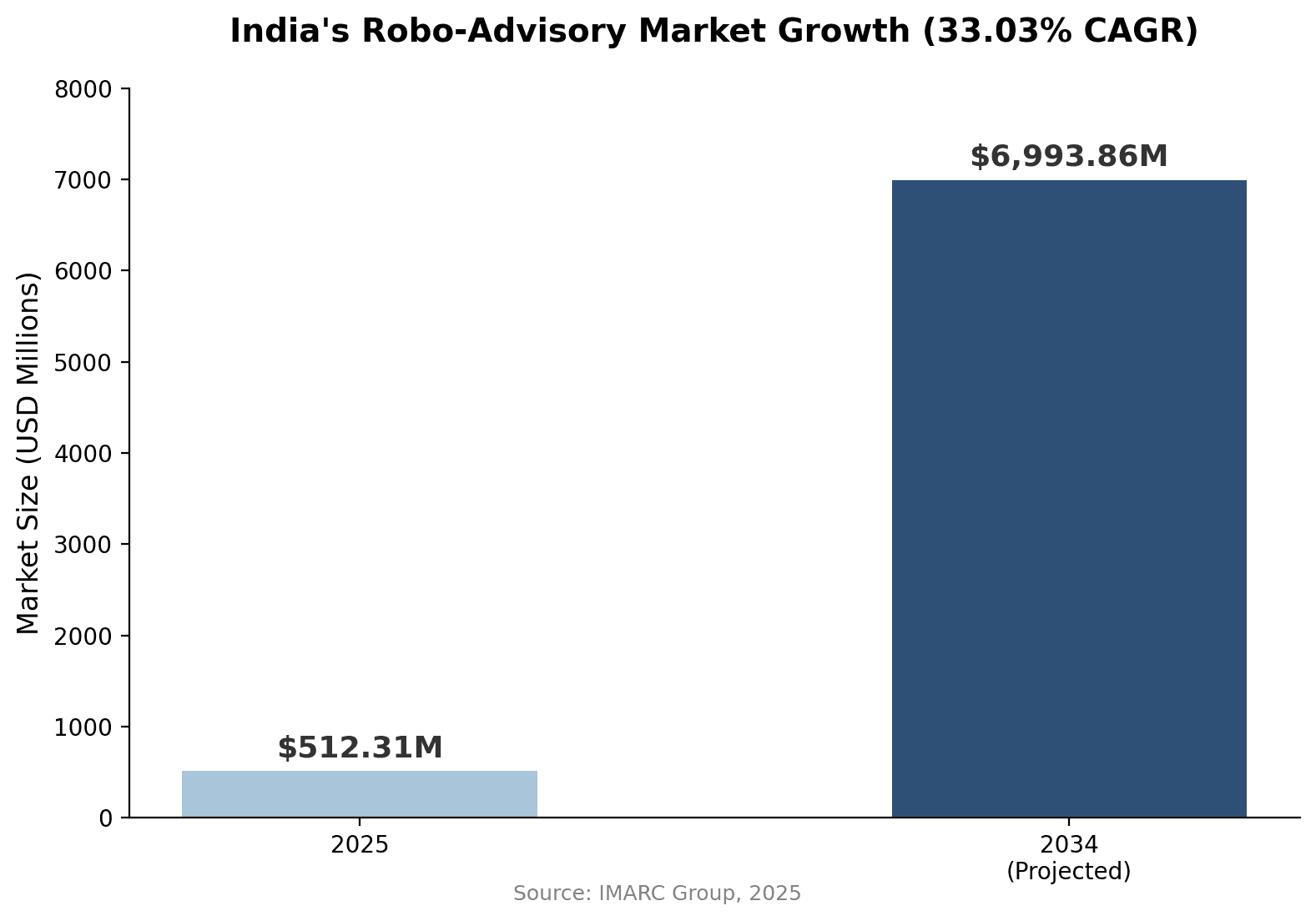
The scale is real. India's robo-advisory market was valued at USD 512.31 million in 2025 and is projected to reach USD 6,993.86 million by 2034, growing at a CAGR of 33.03%. That is not a niche experiment; it is a structural shift in how ordinary investors access advice.
Part of the reason for this growth is a genuine access gap. India has only 967 SEBI-registered Registered Investment Advisors (RIAs) serving more than 20 crore investors. AI-led platforms are filling a gap that human capacity alone cannot close.
Where AI Genuinely Wins
AI is not just cheaper; in several respects, it is structurally better than the traditional advisory model.
Elimination of distribution commission bias. Algorithmic recommendations are not influenced by which mutual fund pays a higher trail commission.
Consistency. AI does not panic-sell during a correction or get swept up in market euphoria. It applies the same logic every time.
24/7 availability. This matters more than it sounds, especially for investors managing Indian portfolios from abroad, across time zones where a human advisor simply isn't reachable at 11 pm IST.
Cost efficiency. Robo-advisory has made basic financial guidance accessible to investors who previously had none, because traditional advisory fees didn't make sense for smaller portfolios.
Data processing at scale. Fund screening, portfolio analytics, and tax-loss harvesting alerts happen instantly, across thousands of data points a human advisor would take hours to review manually.
For a large segment of first-time or straightforward investors, this is a meaningful upgrade over having no advice at all.
Where AI Falls Short: The Gaps That Actually Cost You
The limitations show up precisely where the stakes are highest.
Complex, multi-variable financial situations: A business owner with irregular income, a family with multiple properties, or someone approaching a major liquidity event do not fit neatly into the rule-based models most AI tools run on.
Cross-border tax: This becomes most visible for NRI investors. DTAA (Double Taxation Avoidance Agreement) claims, FEMA compliance, and NRI-specific reporting requirements need human judgment, not automation.
In fact, 68% of NRIs report encountering compliance issues in wealth transfer, precisely the kind of problem an algorithm isn't built to catch. With 32 million NRIs currently managing multi-jurisdictional portfolios, this isn't an edge case; it's a large and growing population with needs current AI tools weren't designed for.
Behavioural coaching: A market crash is another gap. AI can notify you that your portfolio has dropped 15%. It cannot talk you off the ledge, explain why staying invested still makes sense for your specific goals, or hold your hand through the discomfort the way a trusted financial consultant can.
Estate and succession planning across jurisdictions: Especially relevant for NRIs with assets in more than one country, it involves legal nuance that current AI platforms are not equipped to navigate.
And then there's the accountability question: who is responsible when AI advice goes wrong? A registered advisor operates under a fiduciary duty and can be held accountable. An algorithm's recommendation, when it fails, often leaves the investor with no one to turn to.
This is the core distinction that gets lost in the "AI vs. human" framing. It's not that AI is bad at its job, within its scope; it's often faster and more consistent than a person. The issue is scope: the rule-based systems are excellent at repeatable, well-defined tasks.
They struggle the moment a situation requires interpreting intent, weighing competing priorities, or making a judgment call that doesn't have a clean, precedent-based answer. Most of the financial decisions that actually move the needle over a lifetime- how to structure an inheritance, whether to prioritise paying off a home loan or investing surplus cash, how to plan for a child's education abroad while managing NRI tax exposure- fall squarely into that second category.
What Indian Investors Are Actually Choosing
Here's the interesting part: Indian investors aren't picking a side.
The hybrid model dominates: 61.5% of India's robo-advisory market in 2025 is made up of hybrid platforms that combine algorithmic tools with human oversight, not pure robo-advisory alone.
That number tells its own story. The market has already answered the "AI vs. human advisor" debate, and the answer is neither; it's AI plus human, working together rather than one replacing the other.
Regulators are moving in the same direction. SEBI's AI RIA registration framework is expected by 2027, signalling that oversight, not full automation, is where policy is headed. Tools to flag DTAA-related issues are also expected to enter beta between 2026 and 2027, another sign that the industry itself sees these as gaps still being built out, not problems already solved.
It also helps to look at who's actually investing through these platforms. India now has over 125 million online investors, using platforms such as Zerodha and Groww, and a separate study found Indian investors scoring around 3.0 out of 5 on robo-advisory adoption, meaningful uptake, but nowhere near full reliance.
Investors are using AI tools alongside human guidance, not instead of it. That middle ground, comfortable with automation for the routine stuff, but still wanting a person accountable for the important stuff, is where the market is actually settling, regardless of how the debate gets framed online.

So, Should You Use AI or a Financial Advisor?
This isn't a binary decision; it depends on where your financial life actually sits on the complexity spectrum.
If your financial situation is simple: a salaried income, a handful of mutual funds, a clear savings goal, AI tools deliver genuine, measurable value. Use them. They're fast, low-cost, and unbiased.
If your situation is complex: business income, cross-border assets, estate planning, or a major life event like relocation, inheritance, or a return-to-India transition, a qualified financial consultant with fiduciary accountability isn't optional. It's necessary.
The real cost of getting this wrong isn't always immediate. It shows up later, in a missed DTAA claim, a compliance notice, a portfolio that wasn't structured for the goal you actually had. AI won't catch what it wasn't built to see.
The honest answer isn't AI versus financial advisors; it's knowing which one your situation actually calls for, and often, using both.
Fincart combines the efficiency of technology with the judgment of experienced financial advisors, using data and automation where they genuinely help, and human expertise where complexity, cross-border compliance, or major decisions demand it.
Talk to a Fincart advisor today and get a financial plan built around your actual situation, not a generic algorithm.
FAQs
Can AI replace a financial advisor in India?
For simple, straightforward financial needs, AI tools can handle a lot on their own. For complex situations, business income, NRI compliance, estate planning, a human financial advisor is still necessary for judgment and accountability that algorithms can't provide.
Are robo-advisory platforms safe and regulated?
Platforms like Kuvera, Scripbox, and Groww operate within SEBI's existing regulatory framework, and a dedicated AI RIA registration framework is expected by 2027 to formalise oversight further.
What can a financial advisor do that AI cannot?
Behavioural coaching during market volatility, judgment on complex or unusual financial situations, fiduciary accountability, and cross-border tax and estate planning are all areas where human expertise remains essential.
Is AI financial advice suitable for NRIs?
AI tools can help with routine tasks like SIP tracking and portfolio monitoring, but NRI-specific issues, DTAA claims, FEMA compliance, and multi-jurisdictional tax typically require a financial consultant familiar with cross-border rules.
What is a hybrid financial advisory model?
It's an approach that combines AI-driven tools for efficiency and data processing with human advisors for judgment, complex planning, and accountability. It's currently the dominant model in India, making up 61.5% of the robo-advisory market.
How do I know which one I need?
If your finances are straightforward, AI tools alone may be enough. If you have cross-border assets, business income, or upcoming major life decisions, start with a conversation with a qualified financial advisor who can assess the full picture.
Read Important Disclosures